Sustainable Microenterprise and Resilient Transformation (SMART)
Sub-Sector: Dry Fish Processing and Trade.
Why SMART matters for the coast
Bangladesh's long coastal region, especially the vast char areas of Barguna and Patuakhali districts, is the heart of the country's fisheries resources. Life and livelihoods here depend largely on the sea and rivers. In this context, dry processing has survived for centuries as a traditional, labor-intensive and highly profitable economic activity — a source of income for local fish harvesters and for exports to domestic and foreign markets, strengthening the fisheries sector's contribution to the national economy.
However, this promising industry carries risks. The traditional method of dry processing pollutes local drinking water sources and soil through the release of harmful chemicals and waste during salting and sun drying — directly affecting the health of dry workers, processors, and the surrounding community, and calling the industry's sustainability into question.
Traditional dry fish processing site, coastal Barguna
General Information
MIS & Documentation Officer (1), Finance & Accounts Officer (1), Assistant Technical Officer (2)।
What SMART aims to achieve
To promote environment friendly safe dry fish production and marketing by micro-entrepreneurs in the face of climate change.
Expansion of local, domestic and international markets for dried and marine fish.
Methodology
Identify & Include
Identifying MEs involved in dry fish processing and including them in the project.
Capacity Building
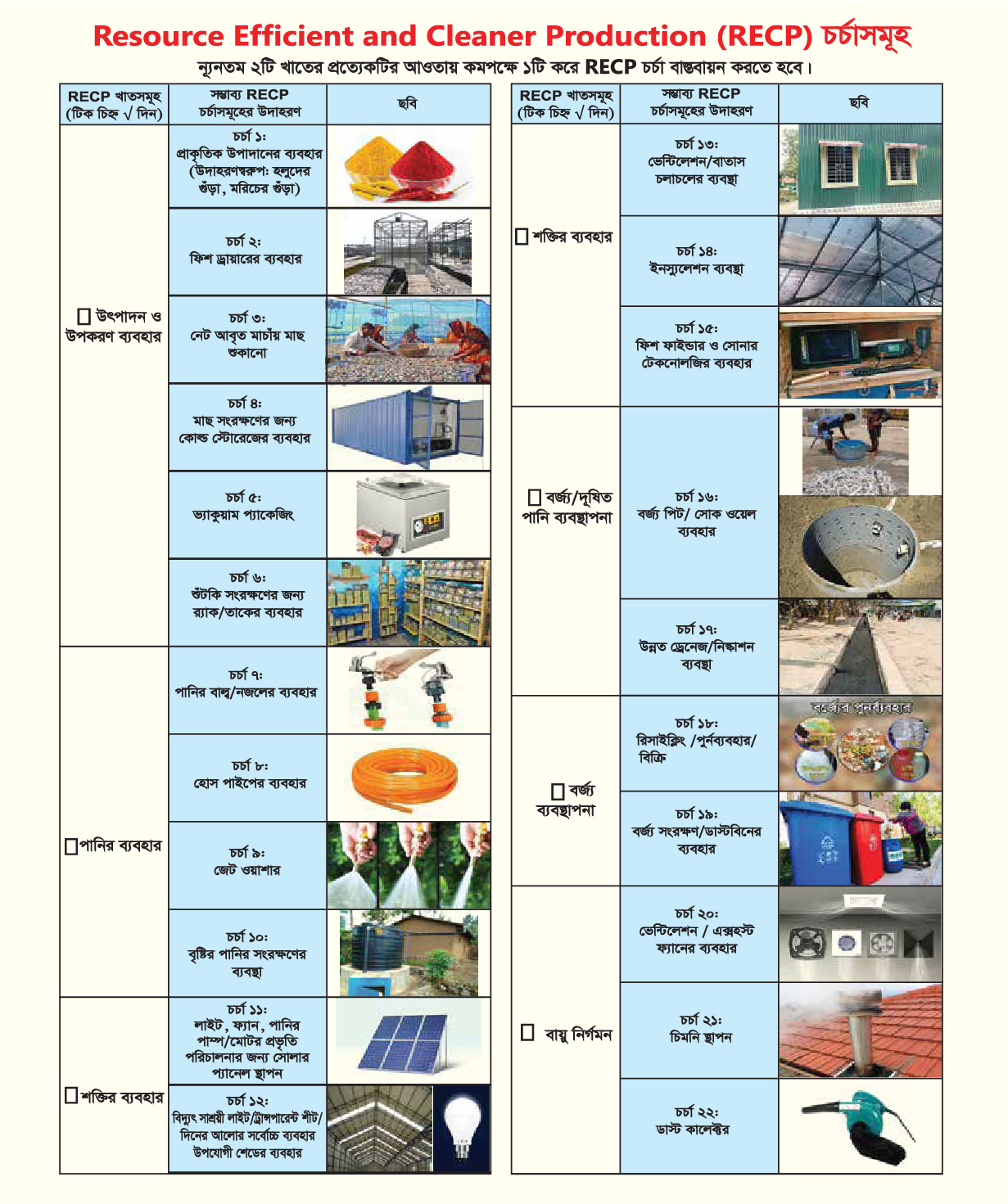
Building skills of MEs through training on Environment friendly Safe Dry fish processing, Waste management and OHS, Climate Resilient RECP (Resource Efficient and Cleaner Production) and other subjects.
Flexible Loans
Providing flexible loans, subject to RECP implementation.
Grants & Infrastructure
Providing grants, infrastructure development, drying and surrounding-environment development, and related support systems.
RECP training session with small entrepreneurs
Notable Achievements
Progress so far under the SMART project.
Small entrepreneurs have implemented RECP practice.
Environmental clubs formed under the project.
Small entrepreneurs arranged for training in 30 batches on climate vulnerability and RECP practice.
MEs received Training on Environment friendly safe dry fish processing.
MEs received Training on waste management and Occupational Health and Safety (OHS).
Plastic Recycle Hub.
Mini cold storage
Establishment Water, Hygiene and Sanitation (WASH) facility, fish dryer and dustbin in Dry fish production fields.
Expected Results
Program Progress
Project Inception Workshop — 23 April 2025
Held with stakeholders at all levels for the successful implementation of the project. The chief guest was Mr. Md. Shafiul Islam, Deputy Commissioner of Barguna.
Representatives from different organizations attended, including small entrepreneurs involved in dry production, owners of artisanal fishing trawlers, local journalists, social workers, and teachers.
Project inception workshop, Barguna
Loan & Grant Distribution Program
Of 1,000 small entrepreneurs, 993 have been provided SMART-Agrasar loans and Common service loans (CSL). All loan recipients are implementing at least 2 RECP practice from different two domains of 6 domains (22 practices total).
Staff Skill Development Training
A one-day staff skill development training was organized at the SANGRAM Training Center in Barguna for staff of all branches involved in the project (19 April 2025), followed by a refresher training (11 October 2025).
Participants included SANGRAM's Zonal Manager, Area Manager, Branch Manager, Accounts Officer, and Field Staff.
Establishment of Environment Clubs
6 environment clubs established under the SMART Project sub-project, with monthly meetings organized in each. Their main objective is to prevent environmental damage by raising public awareness and to make micro-enterprises climate-tolerant and sustainable through resource-saving green production practices.
Example: the "Patharghata Model Environment Club" of Patharghata Sadar Upazila organized tree plantation at Patharghata Degree College.
Environment club meeting / tree plantation activity
Environment & Grievance Governance
Environment and Climate Change Unit (ECCU)
Focal Person: ANM Ashraf Uddin, Assistant Director
Members: Reshmatuzzaman, Senior Director (Human Resources & Administration); Md. Fahad Hossain, Environment & RECP Officer, SMART Project
Meets every 3 months.
Grievance Redressal Committee (GRC)
Chair: Md. Masud Sikder, Director (Training)
Member: Reshmatuzzaman, Senior Director (Human Resources & Administration)
Formed to file, redress, and advise on complaints related to sexual exploitation, sexual harassment, and related matters.
This effort to produce and market sustainable, toxin-free dried fish using modern methods is a groundbreaking step to strengthen the economic and social foundation of coastal Bangladesh. Its successful implementation will mitigate health risks, prevent environmental pollution, and ensure product quality — helping the dried fish industry overcome its traditional limitations and transform into a modern, competitive, and credible food production sector. We firmly believe the coastal region's neglected economic potential will be effectively utilised, new employment created, export earnings increased, and the quality of life of all concerned sustainably improved.